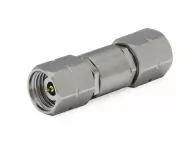
Precision RF adapters for laboratory, test, validation and microwave systems. This category includes coaxial solutions designed to provide more controlled RF performance, higher mechanical stability and better repeatability compared to standard RF adapters.
Order code: ADA-01
Stock: 10 pcs
Order code: ADA-101
Huber+Suhner 31_PC35-50-0-1/199_UE
Stock: 48 pcs
Order code: ADA-102
Stock: 7 pcs
Order code: ADA-122
Stock: 17 pcs
Order code: ADA-123
Stock: 17 pcs
Order code: ADA-125
Stock: 0 pcs
Order code: ADA-129
Stock: 12 pcs
Order code: ADA-134
Stock: 10 pcs
Order code: ADA-135
Stock: 10 pcs
Order code: ADA-14
Stock: 0 pcs
Order code: ADA-145
Stock: 45 pcs
Order code: ADA-146
Stock: 4 pcs
Order code: ADA-15
Stock: 10 pcs
Order code: ADA-151
Stock: 13 pcs
Order code: ADA-152
Stock: 10 pcs
Order code: ADA-153
Stock: 6 pcs
Order code: ADA-157
Huber+Suhner 33_MMPX-SK-50-1/199_NE
Stock: 0 pcs
Order code: ADA-158
Huber+Suhner 32_PC1-50-0-1/11-_UE
Stock: 0 pcs
Order code: ADA-159
Huber+Suhner 31_PC1-50-0-1/111_UE
Stock: 0 pcs
Order code: ADA-16
Stock: 0 pcs
Order code: ADA-167
Stock: 2 pcs
Order code: ADA-17
Stock: 4 pcs
Order code: ADA-170
Stock: 6 pcs
Order code: ADA-20
Stock: 34 pcs
Order code: ADA-23
Stock: 20 pcs
Order code: ADA-28
Stock: 10 pcs
Order code: ADA-32
Stock: 38 pcs
Order code: ADA-33
Stock: 0 pcs
Order code: ADA-38
Stock: 8 pcs
Order code: ADA-39
Stock: 8 pcs
Order code: ADA-40
Stock: 10 pcs
Order code: ADA-41
Stock: 10 pcs
Precision RF adapters are coaxial components used when connection quality can affect system performance or measurement reliability. They are suitable for RF and microwave applications in laboratories, validation, testing, system integration and measurement benches where mechanical stability, repeatability and electrical performance are more critical than in a simple standard interconnection.
In this category, the term precision identifies RF coaxial adapters designed for applications where parameters such as VSWR, return loss, insertion loss, operating frequency, material quality and connection stability must be evaluated with greater attention. Actual specifications may vary according to connector series, geometry and construction of each individual product.
A precision RF adapter is recommended when the adapter does not only provide a connection, but also contributes to the overall quality of the RF chain. Compared to standard adapters, this family is more suitable for contexts where the connection must maintain more stable performance, especially in measurement, test or microwave-frequency applications.
| Requirement | Why it matters | Typical application |
|---|---|---|
| More reliable RF measurements | A more stable connection helps reduce the uncertainty introduced by the coaxial interface. | RF laboratory, component validation, comparative measurements |
| Low reflection | Controlled VSWR or return loss values help maintain better impedance matching. | RF chains, microwave systems, test benches |
| Low loss | The adapter insertion loss can become relevant in sensitive connections or measurements. | RF testing, low-power signals, loss measurements |
| Connection repeatability | Mechanical stability helps maintain more consistent results across repeated connections. | Testing, laboratory work, validation procedures |
| Microwave applications | At higher frequencies, geometry, materials and interface quality become more critical. | Microwave systems, RF instrumentation, high-frequency integration |
Selecting a precision RF adapter requires a more careful review of electrical and mechanical parameters. In addition to connector compatibility, it is important to consider the declared maximum frequency, impedance, interface quality, materials, plating and expected operating conditions.
| Parameter | Why it should be checked | Selection note |
|---|---|---|
| Connector series | Defines mechanical and electrical compatibility with cables, instruments and components. | Check the interface, gender and mechanical connector standard. |
| Maximum frequency | The adapter must support the required operating band without introducing limitations. | Always check the declared frequency in the datasheet. |
| Impedance | Consistent impedance reduces the risk of mismatch along the RF chain. | Most RF applications require 50 Ω impedance. |
| VSWR / return loss | Indicates the level of reflection generated by the interface. | Especially important in measurement, test and microwave applications. |
| Insertion loss | The loss introduced by the adapter can affect power budget or measurement accuracy. | To be evaluated when the connection is part of a sensitive RF chain. |
| Materials and plating | Influence ruggedness, stability, conductivity, wear resistance and environmental behavior. | Check body, contacts, plating and dielectric material in the datasheet. |
| Durability | Becomes relevant when the adapter is subject to frequent connection and disconnection cycles. | Check the declared number of mating cycles, when available. |
Precision RF adapters may be available in in-series or between-series configurations, with straight, right-angle or panel-mount geometries. The correct choice depends on the required interface combination, operating frequency and performance level needed in the application.
| Configuration | Description | When to consider it |
|---|---|---|
| In-series | Adapters between connectors of the same family or series. | When the same interface must be maintained with a different gender or mounting configuration. |
| Between-series | Adapters between different connector series. | When two different coaxial interfaces must be connected while maintaining adequate RF performance. |
| Straight | Linear configuration for direct connections. | When the installation space allows a straight coaxial path. |
| Right-angle | 90° or non-linear configuration. | When space, routing or mechanical access constraints are present. |
| Panel-mount / bulkhead | Adapters designed for feedthrough or mechanical fixing. | When the connection must be integrated into panels, enclosures or equipment. |
Precision RF adapters are used in contexts where the coaxial connection must contribute to system stability and quality. They are especially suitable for technical environments where adapter selection must be consistent with measurement, frequency, repeatability and integration requirements.
| Area | Typical use |
|---|---|
| RF laboratory | Connections between instruments, cables, fixtures, components and devices under test. |
| Validation and testing | Connections in test benches where stability and repeatability are important. |
| Microwave systems | Integration of coaxial interfaces in higher-frequency applications. |
| RF instrumentation | Adaptation between measurement instruments, accessories, cables and RF devices. |
| Technical integration | Connections in equipment, subsystems and configurations where interface quality is relevant. |
Standard RF adapters are suitable for common coaxial connections, connector conversion and general-purpose applications. Precision RF adapters are recommended when the connection requires greater attention to RF performance, mechanical stability, operating frequency and repeatability.
When the application involves VNA ports subject to frequent connections or direct protection of the instrument port, it may be appropriate to evaluate dedicated NMD, RUC or connector saver adapters. These solutions belong to an even more specific area, focused on protection and repeated use on measurement ports.
Welco supports the selection of precision RF adapters for laboratory, test, validation, instrumentation and microwave system applications. When requirements involve frequency, VSWR, insertion loss, materials, geometry, interface or form-fit-function compatibility, the most suitable configuration can be evaluated according to the application specifications.
 English
  Italiano
  Deutsch
  Français
  Español