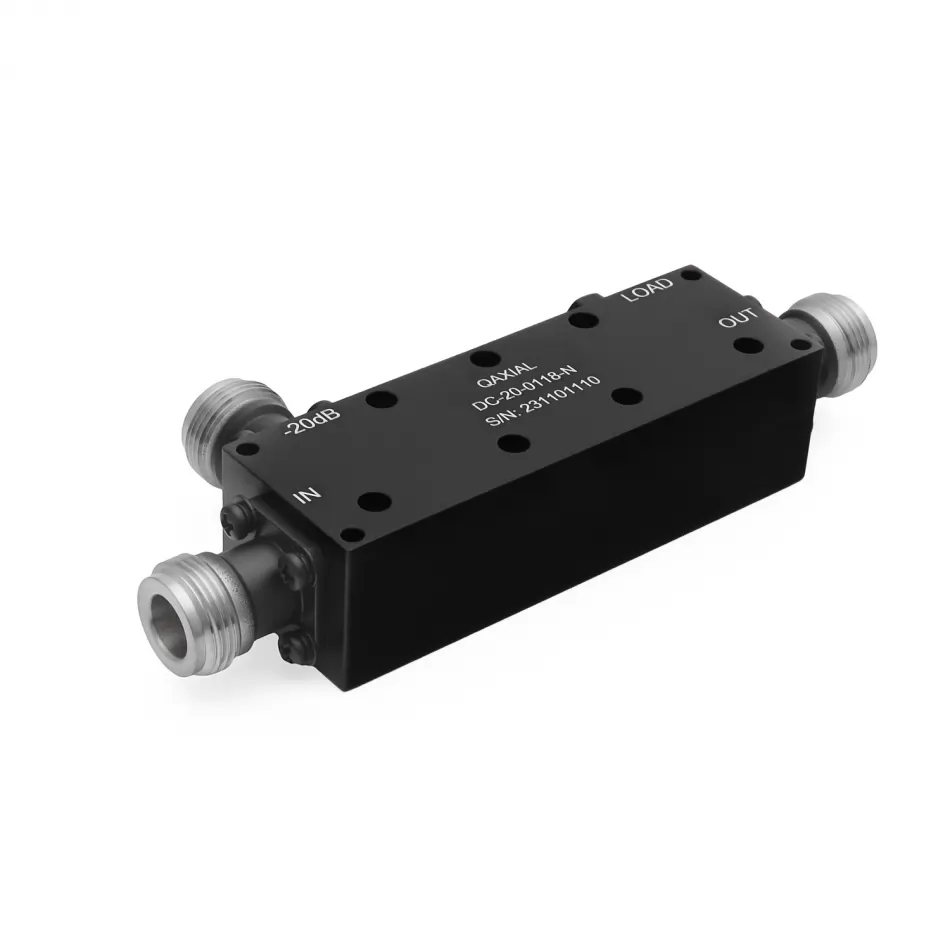
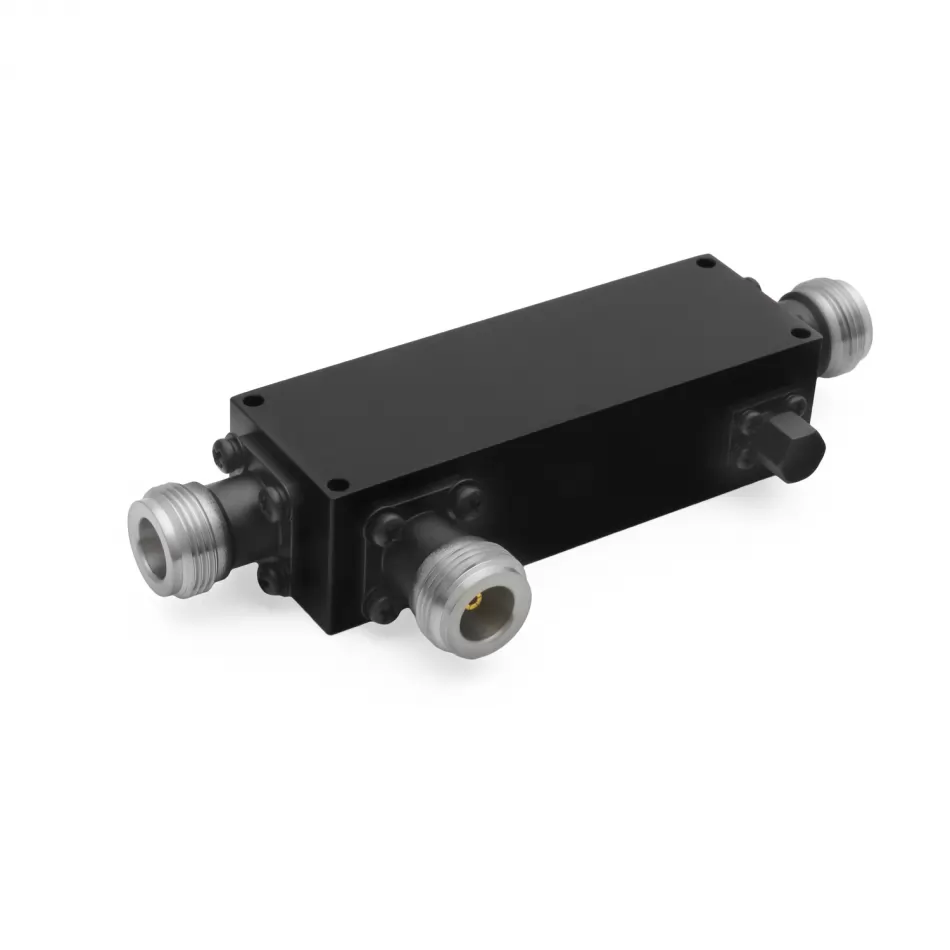


RF directional coupler 20 dB engineered for professional power monitoring and test & measurement in RF systems where a rugged interface and reliable power handling are required. With its N-Type female connectors, this model is a practical choice for bench setups and field-ready installations that use standard N-Type cabling.
The DC-20-0118-N covers 1 to 18 GHz at 50 Ω, supporting common RF chains used in telecom, industrial RF and general-purpose microwave testing. The mechanical interface follows MIL-STD-348A, ensuring predictable mating and compatibility with professional instrumentation and assemblies.
With a nominal 20 dB coupling, the coupled port provides a relatively high sample level, useful when connecting power meters or monitoring receivers without adding external gain. The coupler maintains VSWR ≤ 1.60 across the operating band, helping keep reflections under control. A directivity ≥ 10 dB supports meaningful separation of forward and reflected power for monitoring tasks.
On the main line, insertion loss is limited to 1.2 dB, minimizing impact on system link budgets. For wideband measurements, a coupling flatness ≤ ±1.0 dB improves consistency across frequency, which is especially relevant in swept tests and broadband verification.
The coupler supports up to 50 W continuous input power, making it suitable for moderate-power RF chains and production verification where thermal margins matter. The construction is designed for professional RF environments, with an aluminum alloy housing and stainless-steel connector bodies.
Operating temperature is specified from -40 °C to +85 °C. The product is compliant with RoHS 3 and REACH, easing integration into regulated applications.
A 20 dB directional coupler is typically selected when a moderate signal sample is required on the monitoring path, offering a good balance between measurement level and loading of the main transmission line. It is well suited for feeding power detectors or measurement instrumentation while limiting the impact on the RF path. When only minimal sampling is needed, a 30 dB option may be more appropriate.
The datasheet includes typical S-parameter curves for the 20 dB configuration across the full band, supporting quick validation during system integration and acceptance testing.
 English
  Italiano
  Deutsch
  Français
  Español
  DCN-001 -
10dB
DCN-001 -
10dB  DCN-003 -
30dB
DCN-003 -
30dB 

